Constructive Solid Geometry
Constructive Solid Geometry (CSG) is a geometry representation in which models are created through boolean combinations of surfaces, cells, and universes. CSG models are most commonly used for Monte Carlo (MC) neutronics simulations. While each MC code has their own syntax for defining the CSG model, the underlying theory for creating CSG representations is the same throughout. The CSGBase class provides the framework in MOOSE for creating these generic CSG representations of geometries through MOOSE mesh generators. These can then be used by MC codes.
Theory
As stated, a CSG representation is defined minimally as a series of surfaces, cells, and universes.
Surfaces are defined explicitly through surface equations (such as equations of a plane, sphere, etc.). Each surface inherently separates two half-space regions: positive and negative half-spaces. For example, for a plane with the equation the positive half-space represents the region , while the negative half-space represents the region . Similarly, for a spherical surface defined by the equation , the negative half-space represents the region within the sphere while the positive half-space represents the region outside the sphere. Example half-spaces are shown in Figure 1.
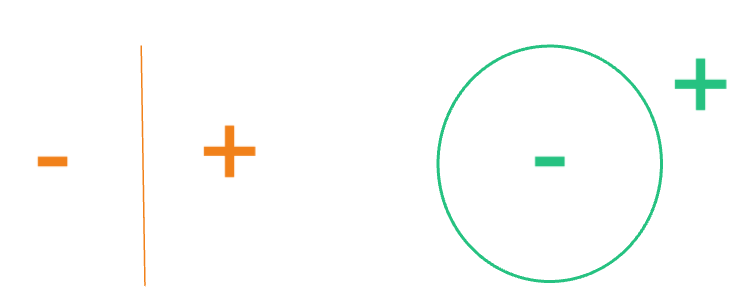
Figure 1: Example depiction of the positive and negative half-spaces defined by a plane (left) and sphere (right).
These half-space regions defined by the surfaces can be combined further as series of boolean operators for unions, intersections, and complements to further define more complex regions. For example, if we wanted to use the surfaces from Figure 1 to define just the left hemisphere, we would define the cell region as the intersection of the negative half-space of the plane and the negative half-space of the sphere (Figure 2).
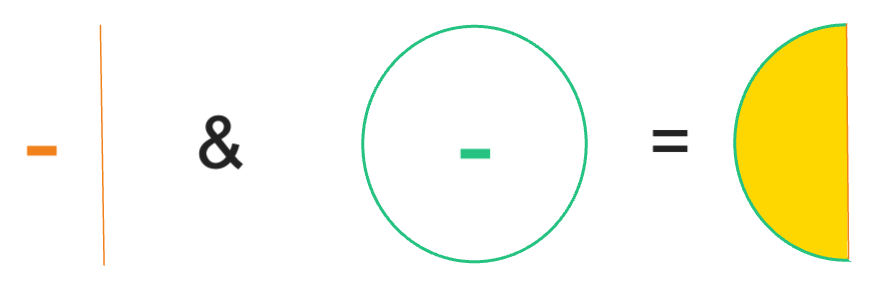
Figure 2: Example depiction of a closed region defined by an intersection of two half-spaces.
Cells are defined by two main characteristics: a region and a fill. The region is defined as described above and defines the domain of the cell. The fill can typically be set as void (i.e., nothing), a material (placeholder type for now, this will be expanded in future works), a universe, or a lattice.
Universes can then be optionally defined as a collection of cells, which can then be used to either fill other cells, or used repeatedly throughout a geometry (such as in a repeated lattice). By default, every model will have a root universe, which is the singular overarching universe that all other universes can be traced back to through the tree defined by universes containing cells and cells filled with universes.
Lattices are another optional component. A lattice is the arrangement of repeated universes in a defined structure. Some common types are regular Cartesian or hexagonal lattices (examples can be seen here). Lattices will sometimes contain universes in the elements of the lattice that do not fill the full spatial domain of that element. Therefore, lattices also often rely on a definition of an "outer" fill, usually a single material or another universe, which fills the undefined spatial domain within the lattice. A visual depiction of a lattice with an outer fill is shown in Figure 3.
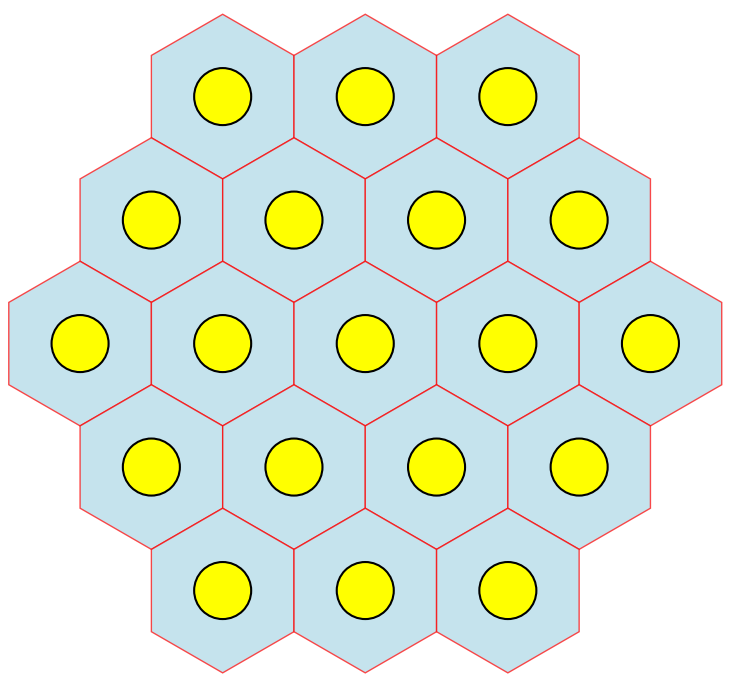
Figure 3: A visual of a regular hexagonal lattice where the red lines represent the boundary of each of the lattice elements, the yellow circles are the spatial extent of the universe that fills each lattice element, and the blue is the "outer" that fills the remaining spatial domain around the lattice element universes.
For a more detailed description of how surfaces, cells, universes, and lattices are represented within the MOOSE mesh generator system, please refer to CSGBase.
How to Generate a CSG Model
The CSG model generation can be invoked on the command line using the --csg-only option with any MOOSE mesh input file. The JavaScript Object Notation (JSON) file that is generated will be called the name of the input file with _csg appended by default. An optional output file name can be provided on the command line (--csg-only <output_file_name.json>).
A CSG JSON file will be produced if and only if all mesh generators in the input file have the generateCSG method implemented. If any mesh generators do not have the generateCSG method implemented, an error will be returned explaining as such. This process is run as a data-only mode so no finite element mesh is produced.
Output
Calling --csg-only will produce a JSON file containing the complete geometric description of the mesh generator input. There are four main sections in the file:
Each item within each section is keyed (a JSON is a dictionary) by its unique name identifier, and the value is the corresponding definition for that item. Detailed description of each type of item in the section follows.
Surfaces
Surfaces contain the following information:
type: the type of surface as defined by the class name that was used to create the surfacecoefficients: the values for each coefficient in the equation defining the surface type (shown in the table below)
type | Equation | coefficients |
|---|---|---|
CSG::CSGPlane | a, b, c, d | |
CSG::CSGSphere | x0, y0, z0, r | |
CSG::CSGXCylinder | y0, z0, r | |
CSG::CSGYCylinder | x0, z0, r | |
CSG::CSGZCylinder | x0, y0, r |
Below is an example JSON surface output for a model with a CSG::CSGPlane at and a CSG::CSGPlane at .
  "surfaces": {
    "inf_square_surf_minus_x": {
      "coefficients": {
        "a": -1.0,
        "b": 0.0,
        "c": 0.0,
        "d": 2.0
      },
      "type": "CSG::CSGPlane"
    },
    "inf_square_surf_minus_y": {
      "coefficients": {
        "a": 0.0,
        "b": 1.0,
        "c": 0.0,
        "d": -2.0
      },
      "type": "CSG::CSGPlane"
    },
Cells
The cells output contains the following information:
region_infix: the infix (human readable) string representation of the equation of boolean operators (listed below) and surface names that defines the cell regionregion_postfix: list of strings representing the postfix (also known as Reverse Polish) notation of the equation of boolean operators (listed below) and surface names that defines the cell regionfilltype: type of fill in the cell ("VOID","CSG_MATERIAL","UNIVERSE", or"LATTICE")fill: for"CSG_MATERIAL","UNIVERSE", or"LATTICE"filltype, the name of the fill object (if"VOID"type, then name is an empty string"")
| Boolean Operator | Symbol Representation in Region Output |
|---|---|
| positive half-space | + |
| negative half-space | - |
| union | | |
| intersection | & |
| complement | ~ |
Internally, CSGBase represents each cell region in postfix notation (also known as Reverse Polish notation). While an infix representation of the region may be easier to conceptualize, postfix notation may be more useful for conversion steps to downstream Monte Carlo codes, as this representation provides an unambiguous precedence ruleset for boolean operators without having to parse through groupings of parentheses. An example of a cell defined as the space inside a box made of six planes and filled with a solid material is below:
  "cells": {
    "cube_box_cell": {
      "fill": "square_material",
      "filltype": "CSG_MATERIAL",
      "region_infix": [
        "+inf_square_surf_plus_x",
        "&",
        "-inf_square_surf_minus_x",
        "&",
        "-inf_square_surf_plus_y",
        "&",
        "+inf_square_surf_minus_y",
        "&",
        "-cube_surf_plus_z",
        "&",
        "+cube_surf_minus_z"
      ],
      "region_postfix": [
        "inf_square_surf_plus_x",
        "+",
        "inf_square_surf_minus_x",
        "-",
        "&",
        "inf_square_surf_plus_y",
        "-",
        "&",
        "inf_square_surf_minus_y",
        "+",
        "&",
        "cube_surf_plus_z",
        "-",
        "&",
        "cube_surf_minus_z",
        "+",
        "&"
      ],
      "transformations": [
        [
          "ROTATION",
          [
            45.0,
            0.0,
            0.0
          ]
        ]
      ]
    }
  },
Universes
Universes are simply defined by the list of the names of the cells that are contained in that universe. If the universe is also the root universe, it will have the designator "root": true. An example of universe output for multiple universes containing various concentric cylinder cells is below. In this example, there is one universe, the default "ROOT_UNIVERSE", which contains one cell and is labeled as being the root universe.
  "universes": {
    "ROOT_UNIVERSE": {
      "cells": [
        "cube_box_cell"
      ],
      "root": true
    }
  }
}
Lattices
Lattice output contains the following information:
type: the type of lattice as defined by the class name that was used to create the latticeuniverses: the array of universe names that define the lattice arrangementoutertype: the type of outer fill in the undefined space of the lattice elements ("VOID","CSG_MATERIAL", or"UNIVERSE")outer: for"CSG_MATERIAL"or"UNIVERSE"outertype, the name of the outer fill objectany other attributes associated with the specific lattice type (e.g., pitch, number of rows, etc.)
Two types of lattices are directly supported in the CSGBase class: CSG::CSGCartesianLattice and CSG::CSGHexagonalLattice. The additional attributes that are provided for each of these types are:
CSGCartesianLattice:nrow: the number of rowsncol: the number of columnspitch: the flat-to-flat distance of a single lattice element
CSGHexagonalLattice:nring: number of rings (consistent with the number of rows)nrow: the number of rows (consistent with the number of rings)pitch: the flat-to-flat distance of a single lattice element
Below is example output for a Cartesian lattice filled with two different universes called sq1_univ and sq2_univ.
  "lattices": {
    "cart_lat_lattice": {
      "attributes": {
        "ncol": 2,
        "nrow": 2,
        "pitch": 5.0
      },
      "outertype": "VOID",
      "type": "CSG::CSGCartesianLattice",
      "universes": [
        [
          "sq1_univ",
          "sq1_univ"
        ],
        [
          "sq1_univ",
          "sq2_univ"
        ]
      ]
    }
  },